|
Destiny Cooper and Anna West began Humanities Amped in 2014 with one class of 25 students. Today, we are in residence at Tara High School, a public school that is part of the East Baton Rouge Parish School System, serving students, educators, and community members. Our vision is to create a dynamic community of lifelong learners and innovative civic leaders, and it is our mission to model and share transformative educational practices that result in people's power to shape their world.
|
am·pli·fy
/ˈampləˌfī/ verb to intensify
to increase the volume to plug into to energize |
|
|
|
At TARA High School
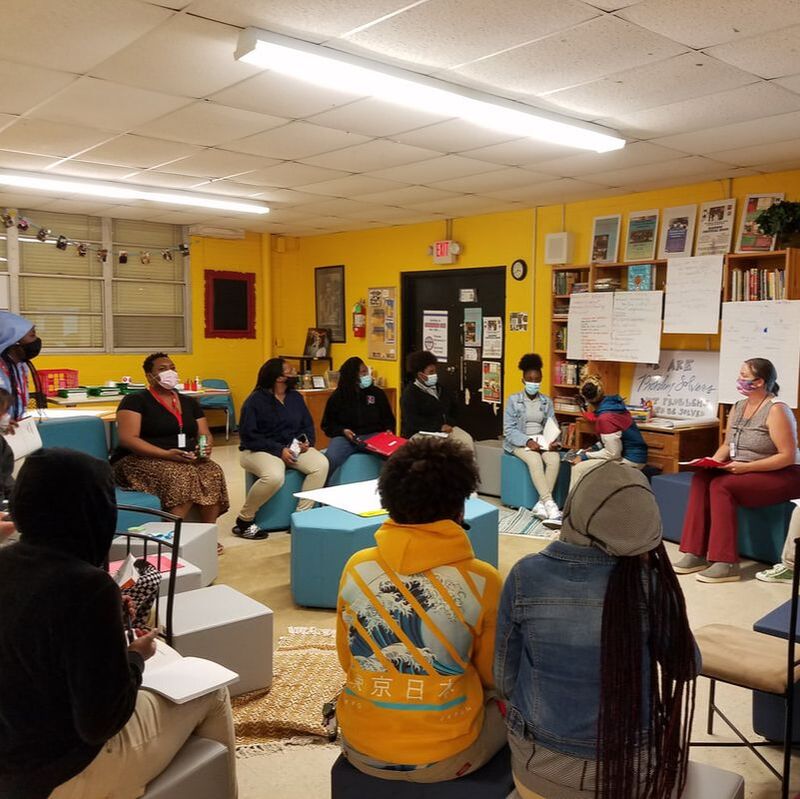
Amplified Classrooms places Amped staff and community volunteers in Tara’s classrooms to accompany students and teachers through hands-on, practical classroom support with a special emphasis on the needs of English Learners.
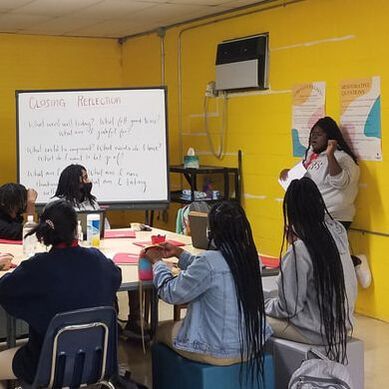
Amped Studio Afterschool students earn stipends while participating in civic engagement and arts projects and taking part in positive youth development activities such as restorative circles, college and career readiness mentoring, and homework support.
Amplified Lunches offer a space to hang out and participate in peer-led activities that bolster student wellbeing and school climate.
Youth Apprentice Leaders League (YALL) fosters democratic engagement and peer-to-peer wellbeing during lunch and after school as students plan and lead activities for their peers.
Community Care Check-Ins offer youth the listening ear of a trained staff member who is able to guide youth to strategies for caring for themselves and making connections to critical health and human services.
Amped Studio Afterschool students earn stipends while participating in civic engagement and arts projects and taking part in positive youth development activities such as restorative circles, college and career readiness mentoring, and homework support.
Amplified Lunches offer a space to hang out and participate in peer-led activities that bolster student wellbeing and school climate.
Youth Apprentice Leaders League (YALL) fosters democratic engagement and peer-to-peer wellbeing during lunch and after school as students plan and lead activities for their peers.
Community Care Check-Ins offer youth the listening ear of a trained staff member who is able to guide youth to strategies for caring for themselves and making connections to critical health and human services.
|
|
|
IN THE COMMUNITY
Amped Learning Greenhouses offer a guided process for youth development practitioners to conduct their own action research. Learning greenhouses ultimately result in strong, transferable forms of knowledge that can propagate throughout communities for the benefit of all.
Youth City Lab is a coalition of four youth organizations, including Humanities Amped, that is developing Baton Rouge’s flagship youth community center on Government Street.
Baton Rouge Area Youth Network (BRAYN) is a network of over 50 youth organizations that is working together with EBRPSS, Wilson Foundation, and Capital Area United Way to strengthen youth services and school-community partnerships. Humanities Amped leaders are on the organizing committee of BRAYN.
Youth City Lab is a coalition of four youth organizations, including Humanities Amped, that is developing Baton Rouge’s flagship youth community center on Government Street.
Baton Rouge Area Youth Network (BRAYN) is a network of over 50 youth organizations that is working together with EBRPSS, Wilson Foundation, and Capital Area United Way to strengthen youth services and school-community partnerships. Humanities Amped leaders are on the organizing committee of BRAYN.
|
|
|
OUR IMPACT
Here in Baton Rouge and across the nation, school pushout/dropout rates average 30% and higher in urban schools; however, three years of data show that the students participating in Humanities Amped are 30% more likely than their peers to graduate from high school on time. In Louisiana, a state that ranks 50th for overall youth well-being, known as the “prison capital of the world,” opportunities to thrive in schools are indeed a matter of life and death.
Humanities Amped “is a home away from home, and that's a big feeling. It's been a long time since I've had that.” - Amped Youth, 2022
Humanities Amped “is a home away from home, and that's a big feeling. It's been a long time since I've had that.” - Amped Youth, 2022
“Humanities Amped reminds us that we have a voice and that we can make a change. We believe that students should have a voice … that school doesn't have to be miserable.”
- Humanities Amped Student
Amped Practices & Methods

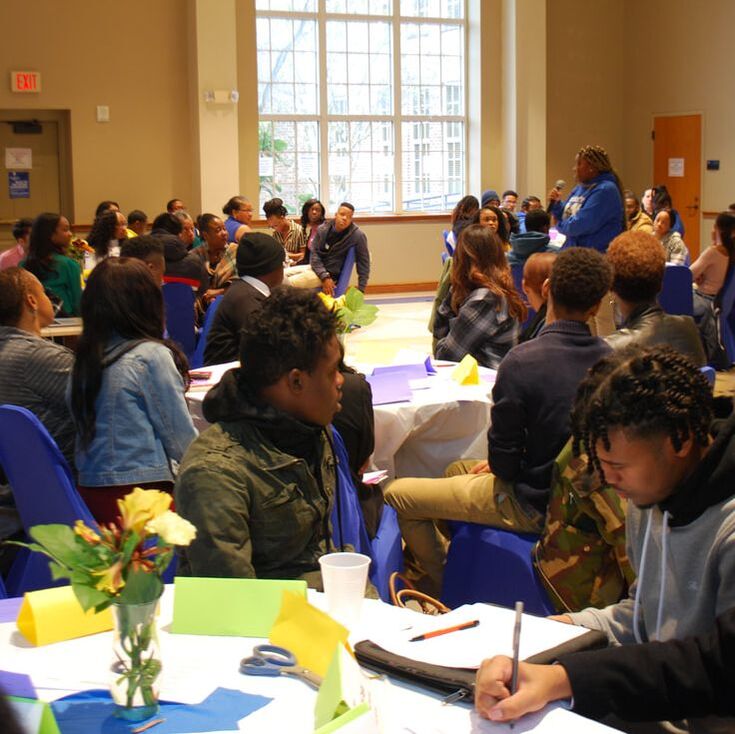
Democratic ParticipationDemocratic Participation is a set of facilitative practices that honor the voices and expertise of each person, thus empowering a group to share responsibility for the group’s design, interactions, decisions, well-being, and outcomes.
Methods include: Dialogue, Discussion, Debate; Classroom- Based Student Council; Consensus and Decision-Making Processes; Opening/ Closing Meeting; Student/Participant Jobs 
Project-Based LearningProject-Based Learning (PBL) is a teaching method in which students learn by actively engaging in real-world and personally meaningful projects (from PBLWorks). Amped PBL emphasizes participatory action research with public-facing forums and outcomes.
Methods include: Challenging problem or question, scaffolded sustained inquiry, student voice and choice, critique and revision; public product/authentic assessment |

Restorative PracticesRestorative Practices are a continuum of informal and formal practices that proactively build relationships and a sense of community to prevent conflict and wrongdoing (from IIRP).
Methods include: Affective Statements and Questions; Circles to Build Community and to address harm; Restorative Conferences; Mind-Body Wellness; Wellness Corner 
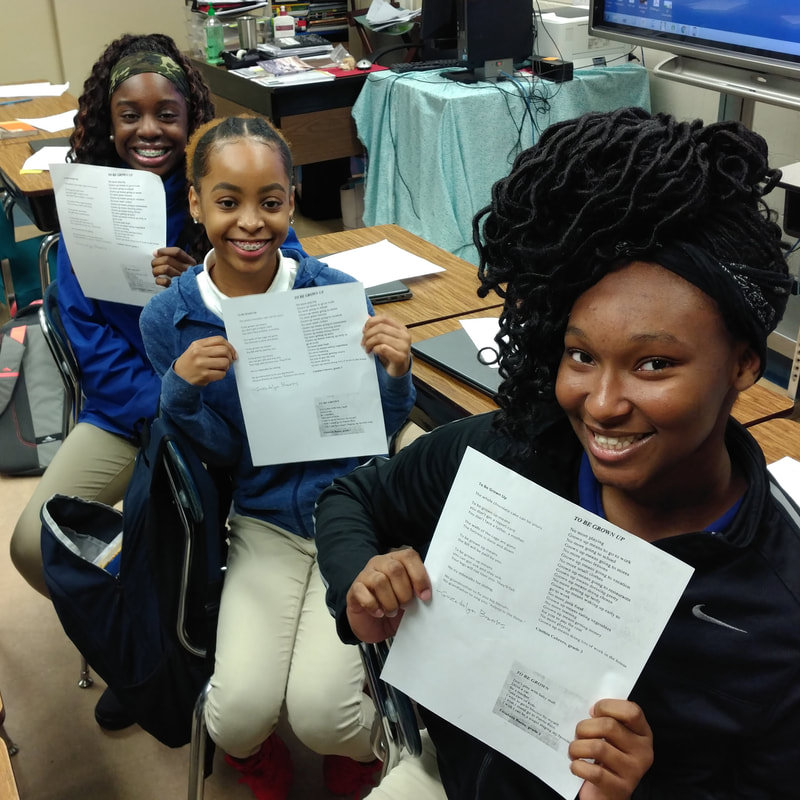
SPoken Word Arts IntegrationSpoken Word Arts Integration is a range of critical literacy practices that emphasize the creative and social dynamics of literacy development by providing students with opportunities to engage multiple culturally responsive literacies.
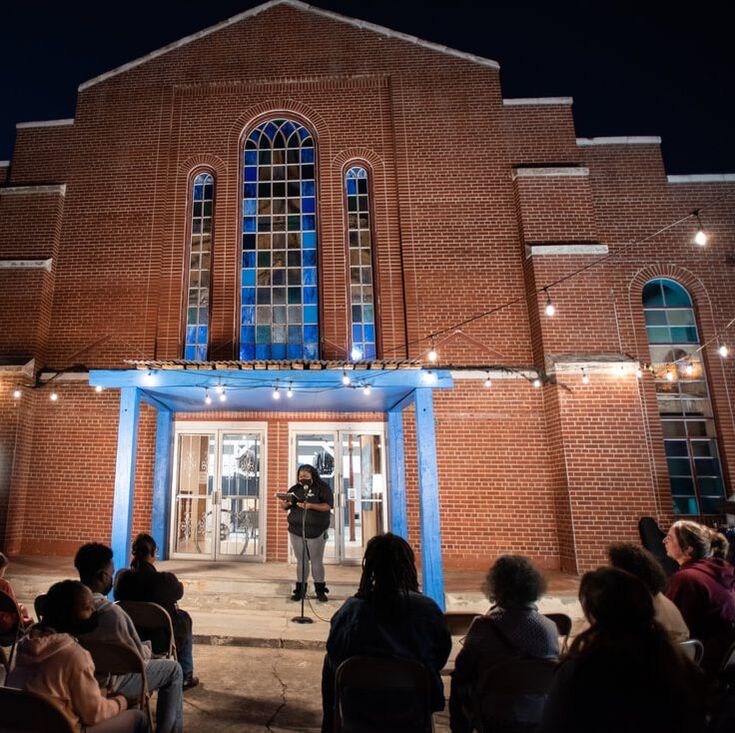
Methods include: Responsive writing from mentor texts; book clubs; informal and formal publication opportunities; narrative exchanges; open mics; family literacy nights |

Collaborative Leadership & LEarningCollaborative Leadership & Learning is a design approach to organizational and learning environments that activates all participants in a dynamic eco-system of cascading mentorship, including expert-led, near-peer, and peer-to-peer learning.
Methods include: Norm setting; collaborative teaching and facilitation structures; peer teaching; reflection and feedback protocols 
Community Resource EngagementCommunity Resource Engagement is a design approach to organizational and learning environments that involves assessing needs and resources from a broad community perspective and developing dynamic pathways for engaging community partners to meet student and family needs.
Methods include: Access & coordinate resources across organizations, multi-tiered support system; integrational community conferences; train and place skilled volunteers |
Core Assets Framework
Humanities Amped programming mobilizes seven core assets to shape approaches to teaching, learning and community culture. This framework is a synthesis of frameworks for culturally responsive-sustaining pedagogies, trauma-informed classrooms, and project-based learning drawn from these sources:
This framework aligns with the EBRPSS walk-through tool to assess teaching using the Compass Teacher Rubric.
- Layer 1 works directly from a framework presented in Cultivating Genius: An Equity Framework for Culturally and Historically Responsive Literacy (Muhammad, 2020) and draws from research-based literature about culturally responsive-sustaining pedagogies (Ladson-Billings, 1995, 2014; Gay 2002, 2010; Paris, 2012)
- Layer 2 draws from SAMHSA’s (Substance Abuse & Mental Health Service Administration) complementary guidance for trauma-informed approaches with consideration of Dr. Shawn Ginwright’s insights on transforming trauma through healing-centered approaches to youth engagement (2016, 2018)
- PBLWorks gold standards for teaching practices and project design are woven throughout both layers
This framework aligns with the EBRPSS walk-through tool to assess teaching using the Compass Teacher Rubric.
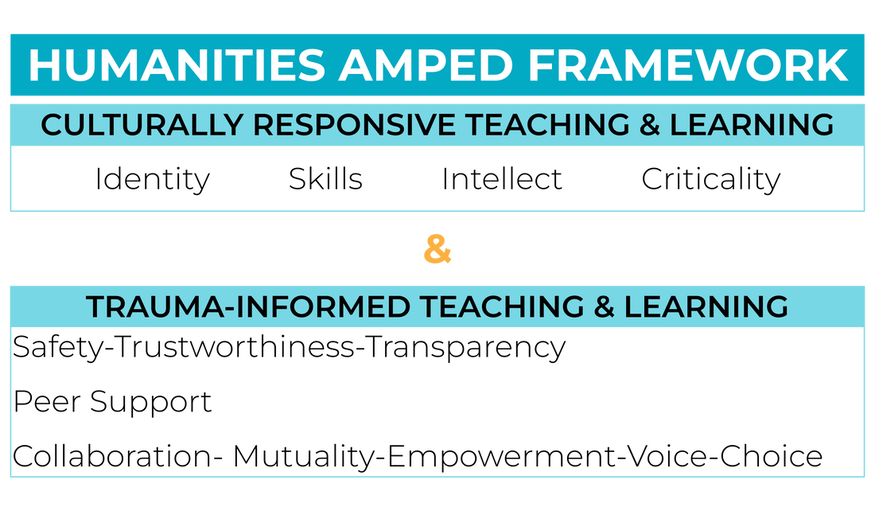
The Amped Framework includes guiding questions, definitions, an implementation rubric, and references.
“WHEN MY GRADES STARTED TO LOWER, TEACHERS NOTICED. THEY ASKED ME WHAT WAS HAPPENING. I DID NOT WANT TO TALK TO ANYONE BECAUSE I FELT THEY WOULD JUDGE ME. BUT THEY TALKED TO ME AND LISTENED. I REALIZED TEACHERS DO NOT JUST TEACH, THEY ALSO LISTEN WHEN WE HAVE PROBLEMS.”
- Humanities Amped Student